


Uncategorised
CHRISTMAS WISHES

A snowy day in Aberdeen Harbour.
Since this is the last newsletter for 2012, it might be time to consider what we might wish for in 2013, those of us with an interest in all things nautical, and more importantly those of us still out there doing the job. So here are a few possible wishes in no particular order.
It is surely time that the IMO got a grip of ship registries. If a country wishes to host a registry they should be able to demonstrate the necessary expertise and organization which would enable them to train seafarers, examine them and award certificates of competency and not least carry out investigations into accidents.
I know we keep talking about it, but could we possibly make some progress towards treating shipmasters who have had the misfortune to be involved in groundings resulting in pollution in a responsible manner, and stop immediately accusing them of being criminals.
Could we review the relationship between the ship-owner and class. Is it right that the insurers of ships rely on the inspection processes carried out by the classification societies who are paid by the ship-owners? Hence of the ship-owner does not like what class are doing they can find themselves another.
Could we start to get real about risk assessments, and start to make them meaningful, ie, a means of keeping people alive and uninjured, rather than a means of arse-covering.
I realize that I could go on. There are many lesser wishes, which might help seafarers enjoy a relatively untroubled life, most of them to do with asking ship-owners to act responsibly, and while many do, there are probably more who do not, so we don’t have a level playing field.
ANOTHER WISH - SOME SORT OF CONTROL OF THE PIRATE PROBLEM
I have a look at the MARITIME BULLETIN on occasion, which is edited by Voytenko Mikhail and is in the main informed by the misfortunes of Russian seafarers. Sadly it is shutting down due to lack of financial support, but if it is able to continue there will be more stories of piracy on both sides of Africa. Last week for instance we learnt about the Myre Seadiver, a vessel manned by a private Russian security service, which has been arrested by the Nigerian authorities. The editor suggests that the reason is that it is a real security service, rather than something else, and cites the tale of the Bourbon Libery 249 which was attacked minutes after its hired locally manned security boat had gone away for some reason. 6 Russians and 1 Estonian were kidnapped, and then released after 2 weeks!!
NOROVIRUS

This winter vomiting virus is very unpleasant, and that’s even if you’re just reading about it. There is nothing worse that large numbers of people in a confined space who are unable to control their bodily functions. Hence the photo of the Oriana which made the news last week because over 400 passengers were suffering from the Norovirus, and their whole cruise and that of other passengers, one assumes, was spoilt.
I clicked on a link in Google and was taken to the Daily Mail website, now becoming notorious for its sensationalist approach to the news. So it was no surprise that the article included a photo of the Captain smiling at us over the telegraphs, probably taken on a happier day, but more surprising that at least one of the readers comments seemed to be directed personally at him. I don’t do Twitter, but I suppose if you do you must get used to people directing comments at you.
A couple of days ago the ship was preparing for a new 23 day Mediterranean cruise, and it made the news again. This time because during the cleaning of the ship, to eradicate the remains of the virus “the disabled passengers were left for hours in the terminal”. They really can’t win can they? And finally we have to remember that even the largest liners are still ships at sea. As usual we could say more!!
THE VOS SAILOR
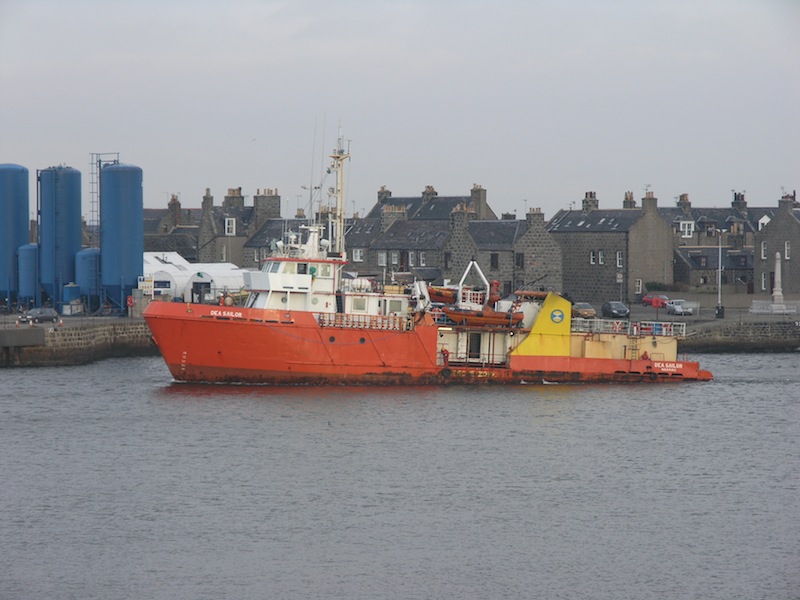
The VOS Sailor when it was the Dea Sailor. entering Aberdeen
As we go to press (I’ve always wanted to use this phrase) the unfortunate VOS Sailor is being towed towards the North east coast of Scotland after being disabled in rough seas. The crew of the North Sea Producer an FPSO were evacuated to other installations as the drifting vessel threatened to collide with it.
At present the news about the accident is scanty, we only know that the ship was swamped by a large wave in high winds, and that one crew member lost his life. The reports say “sustained fatal injuries” so it may be that when the wave came aboard he was caught in its path in some way.
The eleven remaining crew members were winched onto a a Bond Jigsaw helicopter, and the winchman apparently sustained injuries to one foot while remaining on board to supervise the rescue of the crew.
If you look at the photograph of this vessel it may occur to you that this little ship appears to be unsuited to the task of going out into the Northern North Sea, and standing by some sort of installation which would appear to be better equipped for the environment that the ship itself. So it may be appropriate to look briefly at the history of the ERRV – or standby boat as they used to be known.
It was the loss of the Sea Gem in 1965 which resulted in the requirement that offshore installations of all sorts should be provided with a standby boat, and as offshore oil exploration increased the fishing industry provided the service using retired trawlers – side draggers – as they were known. These old ships were seaworthy, but ill suited to the task, mainly due to the lack of maneuvering capability. However, nothing changed until Piper Alpha (25 years ago next year) when the standby vessel Silver Pit, another side dragger, proved itself to have limited capability to take its part in the rescue. The ship was then 40 years old.
Lord Cullen said “I am entirely satisfied that in the above respects (Maneuvering capability) the Silver Pit was essentially unsuitable for the purpose of effecting the rescue of survivors”.
The code which was developed subsequent to Piper Alpha required among other things that standby boats should be provided with “a single screw and azimuthing thruster capable of producing a speed of four knots in the ahead direction or twin screw propulsion and a side thruster”.
The result of these requirements was that in addition to the traditional providers of standby vessels, usually former fishing fleet owners, a number of support vessel owners decided to get into the business either using older units from their own fleets or else going out into the world to find suitable second hand craft.
At least one owner specialized in checking out the bayous in Louisiana for suitable hulls, and brought over to Europe a number of traditional North American ships, had the necessary additional accommodation added on the deck and put them to work. Others used old Norwegian and British anchor-handlers, similarly putting accommodation on the afterdeck, adding the rescue craft and sending them to sea. The VOS Sailor and its sister ship the VOS Scout were built in Vancouver in 1981 as the Canmar Wigeon and the Canmar Teal, and were discovered by a Sealion superintendent laid up in the ice in Canada in 1991. Of course they met the essential requirements of the new standby vessel legislation. If one looks at their specification one might doubt that a 100 bhp bow thruster is powerful enough and wonder whether the 1700 bhp developed by the main engines is adequate, but this is in the light of our experience with much more powerful ships today.
So on the face of it, it seems surprising that there have not been more accidents to standby vessels (ERRVs) out there, and this must be in part due to the experience of those on board them, and the fact that in general if you are not trying to get anywhere quite small ships remain safe in extreme weather. But this is not always true. I was once mate of an anchor handler which was dodging (just hanging about on station) in extreme weather, when a wave pushed in one of the bridge windows. The only system left to us was the steering, and just as well. We ran before the sea for a day while filling in the hole with an engine room plate.
The good news in this rather bleak situation is that the oil companies and standby vessel owners are gradually replacing the old tonnage with new ships. Indeed Vroon, the owners of the VOS Sailor are building new ships, and scrapping the very old supply boats in the fleet at such a rate that it is difficult to keep up with them.
BASKET TRANSFERS

The Island Enforcer from the Island Offshore website.
The recent failings of the Super Puma EC225 helicopter, on one occasion resulting in the deaths of 16 people, have resulted in extensive “reinstatement” of the type. In turn, this has given the personnel departments of the oil companies problems as they have attempted to maintain their crew change schedules.
Hence we have seen a return to the use of the “personnel transfer device” , moving people to and from offshore installations to and from ships. The Island Enforcer, for instance has been hired by Talisman to carry out transfers from Fulmar, Clyde and Auk platforms.
There have also been calls for an alternative means of transport to and from offshore installations due to the recent spate of helicopter accidents. With some apparently calling for a combination of helicopter and ship operations, ie a short ride from the installation by helicopter and a longer ride by ship to a port.
Over time there have been modifications to the original “Billy Pugh” which required one to stand on the outside of a ring, holding on grimly to rope netting while being swung about by the crane. Now there is the Frog, which you sit inside, slightly restrained, and the new Billy Pugh which apparently you stand inside, lightly attached.
Here we are dealing with two diametrically opposed risks, one is that you might fall off but that you would survive if the whole thing fell into the sea. The other is that you won’t fall off, but probably would not survive the fall into the sea inside the device.
TRANSOCEAN AND CHEVRON IN BRAZIL - OR NOT

The Sedco 707 well testing out in Brazilian waters Photo: Tony Poll.
Back in November 2011 there was an oil spill of 3600 barrels on the Frade Field North East of Rio de Janeiro. The exact source of the spill remains obscure to those of us in the public domain, but Youtube videos indicate that it was a small formation blowout which was quickly killed. It’s not too technical, there’s a crack in the seabed from which droplets of oil can be seen drifting up. Then there are pictures after the kill which show occasional droplets emerging.
As a result of this spill both Chevron and Transocean have been banned from operating in Brazilian waters, and despite numerous legal appeals by both companies and, unusually, the Brazilian oil regulator the ban seems to still stand as of 15th October. They have also been fined collectively $11 billion and seventeen of their employees in the country have been threatened with up to 31 years in jail. ANP, the Brazilian oil regulator has stated that there were problems with the Chevron well plan but that Transocean had no responsibility for the accident. They also stated that there was no discernable environmental damage as a result of the accident, nor was any wildlife harmed. ANP are concerned that the banning of the ten Transocean rigs will have an adverse effect on the country’s oil output. And doubtless Transocean must be a bit concerned at the possibility that 7% of its fleet may shortly become unemployed. They would have the choice of finding work elsewhere for them or else selling them to another rig operator.
To put this sanction in perspective when two guys unfortunately died in 2003 after being overcome by gas on Brent Bravo, Shell, the operators of the platform were fined GBP 1,000,000. But on the other hand, of the five major registries of offshore oil rigs, only one, the US flag, required that accidents resulting in the deaths of five or more workers needed to be reported, although all required that even the most minor oil spill be reported.
SHELL SECURITY
I suppose if you are a major oil company you are often going to be in the news pretty often, particularly now that the paparazzi are keeping an eye open for any birds smeared with crude oil, when they aren’t looking for the ones smeared with suntan oil. And so it is for Shell. The Guardian has published an article about Shell’s security costs, which were apparently nearly $1 billion between 2007 and 2009. Much of this was apparently spent in Nigeria. Campaigners in the area suggest that much of Shell’s spend in the country is directed towards the military and the local police, and that these bodies may not always act in the most ethical manner, But what are Shell to do? In 2008 62 employees or contractors were kidnapped and three were killed. It just happens that much of the oil under the earth's crust is located in unfriendly places.
SHIPS AGROUND

This is a photograph which appeared in the Tugs and Towing News a couple of weeks ago. They are two cargo ships which dragged their anchors and found themselves on the beach just outside the Spanish port of Valencia. The accidents were the result of adverse weather.
The photo reminded me of my visit to Las Palmas – on holiday – a couple of years ago. There were quite a few ships at anchor, some of them only a few hundred metres from the shore. They looked pretty close to me standing on the beach, so from their bridges they must have been able to see all the girls in their bikinis with consummate ease. I have also sailed on ships in my youth which took about six hours to fire up the main engines from cold, because first a boiler had to be lit and produce stream and then the steam had to be directed to a steam driven compressor, which finally would provide the compressed air to start the engine.
Surely ship masters are better off today, and can start their main engines in fairly short order, and on receipt of an adverse weather forecast they can up anchor and move off into deeper water. Or, as I write this it occurs to me that maybe they think they would lose their place, if there is a queue.
This is not just a one or two off problem. It seems that nearly all groundings are due to dragging anchors, so either those currently in command lack anchoring ability, or weather forecasting ability.
ONE FROM THE ARCHIVE

The survey ship Kommander Jack entering Hartlepool. Photo Jan Plug.
I am currently dragging some interesting stuff out or my archive, for the perusal of my readers. It can be found on the website somewhere, but there is getting to be so much there that it might take days to find it. This is a short history of the departure of a survey ship, in the Arabian Gulf, which was passed around the safety departments of a number of companies in Aberdeen a few years ago. The name of the ship and its chase boat had been removed, but it is still a fair illustration of the progress of an accident, to a distressing conclusion, from small beginnings. I have no idea what the actual ship looked like, but have used the 30 year old Kommandor Jack as an illustration. The Kommandor Jack is still afloat and working in Nigeria, so it was not her, or anything to do with her or her owners:-
“It was the Xxxx Xxxxxr Survey Vessel. All got off ok and no injuries. This past Wednesday, the ship sank about 300 miles offshore of Iran.
Around 6AM in about 1 meter seas, the navigator went down to the engine room to lower the UBSL pole, so that we could begin surveying. The chain used to lower the pole suddenly snapped. There was no safety chain attached and the flange at the top of the pole, which would have prevented the pole from dropping all the way through the hole flew off. Therefore, the USBL pole fell 3000 meters down to the bottom of the ocean, leaving a 12 inch hole in the ships hull. As you can expect, water started flooding the engine room. Crew members tried to fit a metal plate over the hole, however this proved to be impossible due to the pressure of the water. Non-essential personnel, were immediately transferred by FRC to the chase boat. Meanwhile, the crew continued to try to contain the flooding.
The engines and ship power were quickly shut down, and emergency power was turned on. The pumps proved too small to be effective, so the engine room's watertight door was closed & dogged down. Unfortunately, this door was not exactly watertight, and water proceeded to flood compartment next to the engine room.
Meanwhile, MAYDAY calls were issued from both the OV and the MS. The first to respond was a Coalition Warship, which later turned out to be the USS SEATTLE (AOE 3), a fast combat support ship. Since it would take a while for the SEATTLE to arrive, a Canadian C-130, and a Japanese helicopter were dispatched to the location. These aircraft remained until the end. Soon, a US helicopter also arrived carrying with it 2 large pumps and a damage control (DC) crew to operate the pumps. When the equipment and personnel were safely lowered onto the OV, the helo returned to pick up and deliver a third pump.
Unfortunately, two of these pumps became clogged with debris, and the DC crew were never able to get them to operate. The Commanding Officer (CO) on board the SEATTLE was informed by the DC crew the only chance that the ship had to stay afloat was if divers were dispatched to try and repair the hole. This solution was rejected by the CO. As a last ditch effort, a tarp was unfurled over the side and under the keel to try and cover the hole and slow the flooding. However, this effort proved futile. Eventually, the SEATTLE arrived on site. The CO assessed the situation and decided that despite all efforts, the OV was going to be a "long-term loss." He instructed all crew and instruments to be removed and the ship was then abandoned.
When all crew member were onboard the MS, the Captain and Party Chief made one last trip back by FRC to try and release the second towfish (the first was released earlier by FSSI marine techs) and try retrieve whatever personal effects that they could. Things retrieved included some undergarments, camera, 3 bottles of alcohol, one flip flop (right foot)and one Teva (left foot), various souvenirs. However, things such as wallets, house keys, cell phone, address book, and CD's now reside on the bottom of the Arabian Sea .
It took a few hours before the OV finally sank, but when it happened, she went down by the port bow. Afterwards, MS then began a rather rough 16 hour transit to Muscat, Oman. While the MS was steaming, the crew of the former-OV spent the night consuming the salvaged alcohol, and trying to sleep on spare mattresses, which were placed on the deck for us.
Once we arrived in Oman , it took many hours for officials to take statements and issue visas. Crew members, who were able to save their money and credit cards, supported those of us who lost everything. We left Oman very late Thursday night and spent the next 24 hours on airplanes.
I cannot even venture a guess on what will be the repercussions of this event. Besides our personal losses, my company lost about US$2 million worth of uninsured gear, including 20 km of fiber optic cable (10 km of which was flaked on the deck in two 5 km pieces due to a previous incident). Additionally, it is unknown how much of the data, from the survey, was recovered. I do know that there are already gaggles of lawyers hovering around and I am relatively certain that there will be many lawsuits between my company, our clients and their clients.”
While this was an extremely harrowing experience, I am thankful that everyone was able to safely get off the ship. I am fully aware that things can be replaced, while people cannot. We were very lucky that this happened in daylight hours in calm seas. We were also lucky that we had a chase boat following us and a Navy warship, so close by.
THE STAR PRINCESS
Back in May in this newsletter I wrote about the Star Princess, apparently failing to respond to distress signs, (not really signals) from a small boat, which was photographed by some birdwatchers who had been on the ship.
The birdwatchers informed one of the crew that they thought the guys in the boat were in distress, and were told that the message would be passed on. Nothing happened. Subsequently the surviving crew member of a small boat was picked up by a larger fishing vessel, his two fellow crew having died, and claimed that he had seen a cruise ship, and that it must have been the Star Princess.
Princess Cruises have recently published some evidence that the small boat which had contained the three unfortunate seafarers was not the one photographed by the birdwatcher. They have produced evidence showing that the boat adrift was called 50 Cent and the name was writ large on the bow. Since there is nothing written on the bow of the craft photographed it can’t have been the one.
THE UK ETVs

I suppose we might all have been hoping that the government would change its mind and continue with the ETV service around British coasts, but the sight of two of the former JPKnight vessels in Smit colours the other day may have put paid to all that. However the former Anglian Prince, now the Swedish owned and Maltese registered Herakles has returned to the western isles, until, if I read it right, 2015.
The vessels were put in place as a result of the Braer accident in 1993, when the tanker piled up at the southern tip of the Shetland Island Islands. So for the benefit of our legislators, how often is often for major accidents such as this. The answer – once in a thousand years. So only 999 years to go.
THE VICTORY ET AL

HMS Victory as it is today in Portsmouth Historic Dockyard. It is shown in its original colours in which it fought at Trafalgar.
I am starting this newsletter with the intent of describing and commenting on nothing of any importance, except what I experienced on my holidays, which since I live in Spain, were in Britain.
First on the list is HMS Victory which is the oldest commissioned warship in the British Royal Navy. It has been in its current drydock in the Portsmouth naval base since 1927. I realised that despite my lengthy service at sea, and my remaining enthusiasm for all things nautical I had never visited the Victory. Even when I spent a summer working out of the port I still had not taken to time to make a visit. This was, in a way, due to my lack of enthusiasm for the age of sail, which has changed a bit since I read about the amazing seamanship exhibited by the captains of these ships when they went into battle. If one ship was dismasted another would take it in tow, so that when they sailed past an enemy that vessel would receive broadsides from two ships instead of one.
I had not ever thought about the masts and rigging of the ship until I looked at this photo, and it is obviously missing its topmasts. You would think that sometime in the last 100 odd years they might have replaced them. And I was a bit surprised by the lack of symmetry in the disposition of the main mast. The large spacer between it and the foremast was required so that they had somewhere to stow the small boats, and was more or less standard for the warships of the time.
If you go on board you can see the spot where Nelson fell after being shot by a sniper on the French 74 gunner Redoubtable. But despite this it is not the most exciting ship in the dockyard.
THE MARY ROSE ACCIDENT
The Mary Rose was recovered from the seabed in the Solent in 1984, and might be Britain’s earliest catalogued marine accident. It was built in 1510, and was the first warship to be fitted with large guns, earlier vessels relying on marksmen in the fore and after castles, and finally on hand to hand combat.
In order to keep the ship stable it was felt that the guns should be set quite low down, and the new carvel construction technique allowed the gun ports to be made watertight. However, when the ship sailed on its maiden voyage the ports were opened to fire a salute, and no-one remembered to close them afterwards. A witness statement suggests that when the sails caught the wind the ship heeled over, and the lower deck was flooded through the ports. The ship continued to heel over, capsized and sank. Oh dear that again!
LAKE CRUISERS

The Queen of the Lake on Lake Windermere.
For those who want to go on old marine craft and be transported from one place to another there is no better place to go than the English lakes. The boats there do not suffer from the corrosive effects of salt and so just seem to go on and on.
There are a couple of steamers on Lake Windermere and more on Ullswater, and they have been there since Victorian times. This may be what is charming about them. There is little more to do in the English lakes than go on boat trips, go on bus trips, go on train trips and walk. It is what the Victorian did, and it is what you do now if you go there. We might possibly add “waiting for the rain to stop”, since the lakes are well known for bad weather, but this can be done in public houses (bars for none UK readers), where the standard of the beer has improved beyond recognition in the last twenty years or so.
Also on Windermere there are a number of motor driven wooden boats, doing short runs across the lake, one of which is the “Queen of the Lake” which was transported to London recently to take part in the Queen’s Jubilee celebration as one of the 1000 craft in the Thames Pagaent.
THE WARRIOR

The restored Warrior lying alongside in Portsmouth Dockyard.
Back in 1987 I spent the summer as mate of car ferry, running between Gunwharf in Portsmouth and Fishbourne on the Isle of Wight. Each trip across took 45 minutes and we spent half an hour or so unloading and loading the cars coaches and passengers at each end. The ships were powered by three Voith propellers, two at the stern and one in the bow, a configuration which allowed them to be propelled in any direction. While on passage a helmsman took the wheel which operated the two props at the stern in a way which allowed it to be steered in a conventional manner.
When we had cleared Portsmouth Harbour and approaches we would give the order to the helmsman to head for “The Trees” and he would set course for a bit of barren hillside. When I asked why this particular order, the answer was that there used to be trees on top of the hill. When we headed into Portsmouth Harbour we would give the order “Foudroyant” and the helmsman would head for an old wooden warship well up in the anchorage. During my period of employment there the Foudroyant was loaded onto a barge and towed away to be restored, leaving an empty space up the harbour. We still told the helmsman to head for Foudroyant, and the man would steer for the empty space.
But, getting to the point, one day when we were going about our day to day activities, churning back and forth across the Solent another barge hove into view, this time with the British navy’s first powered warship, the Warrior, on board. Over a day the barge was submerged and the warship floated off and made fast in the dockyard, and I admit, I never gave it another thought.
When I was talking to a friend before our holiday I said we were probably going to the dockyard and he said what a great day out it was, but that he had not managed to visit the Warrior. So, OK maybe it was not so special I thought, but when we bought tickets we could see the Warrior tied up at the closest berth, so we thought we might as well start there.
I only afterwards have found out something about the ship, and how it comes to be, in my view, the star attraction in the dockyard. It entered service in 1861 and was active for twenty odd years, but never saw action. It was quickly outclassed by later warships fitted with thicker armour and rotating turrets and so the Navy attempted to sell it for scrap. No-one wanted it though and so it became the HMS Vernon torpedo school in 1904.
In 1929 further attempts to sell what had now become a hulk were also unsuccessful, and so now dismasted and defunnelled, it was converted into a refuelling pontoon and sited Milford Haven. In 1979 it was rescued by what is now the Warrior Preservation Trust, and towed away to Hartlepool for restoration.
The restoration was breathtakingly detailed, and every aspect of the ship is probably just as it was in 1861 when it entered service. All the guns are in place, including the ones in the junior officers cabins, taking up most of the floor space. All the mess tables are present together with their standard issue plates, knives forks and spoons, and all the firearms are racked and the swords and cutlasses stowed. It is possible to see how the sailors were divided up into 18 man groups, each responsible for its own feeding and cleaning, thus relieving the higher echelons from such responsibilities.
The boilerroom is vast, the bunkers having a capacity of 850 tonnes. Some thing I noticed was the fact that water was contained in tanks with sounding tubes at various points on the deck, as opposed to the Victory, which carried its water in barrels. What were they thinking!
THE CANTON

The Canton painted by Neil Martin.
On 4th August my wife and I had lunch with the man who had in 1962 been Third Mate on the P&O passenger ship Canton. The painting was done by the man who had been, in 1962, my fellow apprentice on the ship. We have all gone our different ways, and the 4th August was the first time the former Third Mate and I had met since the ship had arrived back in the Royal docks, at the end of its last passenger carrying voyage.
My fellow apprentice and I had gone on to join the first Oriana, but the Third Mate had been one of the dozen or so officers, and twenty odd Indian crew who had taken the ship to Hong Kong to hand it over to a scrap merchant.
They had suffered from a particularly authoritarian master who seemed to have had the impression that the passengers were still on board, and in the end a few of the crew remained while a typhoon swept through Hong Kong and waves broke over the deck. This, because the buyers refused to hand over the cheque in case the ship was to sink.
THE BOND EXHIBITION

While in London we took the opportunity of going to the 007 Style Exhibition at the Barbican which was quite good fun. They had lots of the actual stuff and the clothing used in the films, and showed the relevant clips on large screens. I admit I was hoping that in the “Boats” section they would show the sequence in “From Russia With Love”, in which I took a small part. They did not, nor did they show anything from Live and Let Die which surely featured the most spectacular boat chase ever. So to make up for their omission I include a screen shot featuring James Bond escaping in the white boat, while the villains in black boats are about to be incinerated. I was in the black boat closest to the flames. This was not CGI. The fire was created by blowing up bags containing hundreds of gallons of petrol. It was hot!