

Earlier this month (May 2024) the UK Heath and Safety Executive issued a safety notice concerning the use of motion compensated gangways in the wind industry. For those who may be unfamiliar with this sort of activity, it has become common for construction and maintenance of wind generators out at sea to be carried out using motion compensated gangways from the ships to a landing point on the base of the windmill. The ship maintains its station by using dynamic positioning, but obviously this is not a precise activity, it will be subject to wind and wave action, so may move about a bit, and the movement will be taken on by the gangway, which can move laterally and more, importantly, in and out to compensate for the movement of the ship.
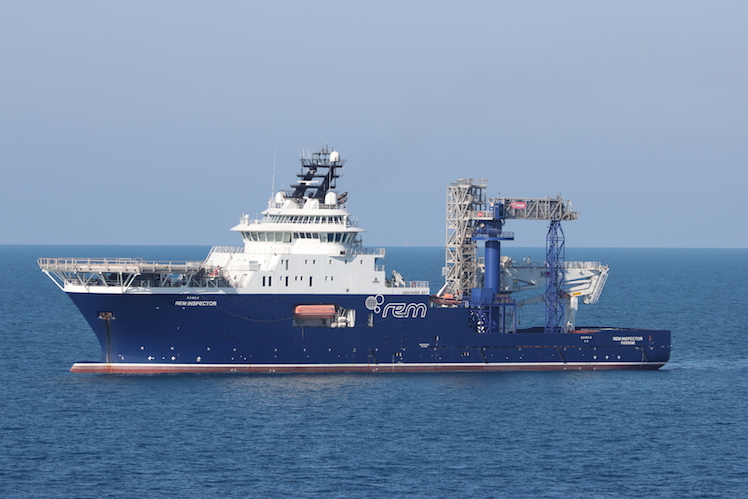
A support ship fitted with a motion compensated gangway. Photo Jan Plug
According to the HSE there have recently be injuries sustained by people “during the deployment and use of motion compensated gangways”.
The HSE don’t go in for graphic descriptions, but it seems that, when people have been crossing between the wind farm installations and the ships, the movement of the moving parts have trapped people’s extremities in some way, or they have been caught by the unexpected “auto-retraction” of the gangway. In this case one can imagine the weather conditions deteriorating, but the ship has hung on maintaining station as best it can while the gangway swivels on its mounting on the ship, and bits of it slide in and out in order to remain connected. On the structure there will be people working away, and obviously there is a reluctance to recall them to the ship, which thereafter would be on standby for weather. The captains of these vessels are, like masters everywhere, in the unwelcome situation of having to decide when the task should be terminated for the safety of everyone involved, and conscious of the fact that that the continued operation of the ship may have an effect on its continued hire. In some offshore environments a cautious approach by the master can result in the charterer thinking that the ship is unsuitable for the task. One way of avoiding this decision altogether is to wait until the gangway has reached the boundary of it safe operation.
The HSE notice then suggests the action which may be required by companies operating motion compensated gangways, in language which is familiar to those working in the offshore oil industry. One of the paragraphs is as follows:
“Motion compensated gangways are designed to move while in use. The hazards from entrapment and shearing between moving parts and falls from the open end of the gangway must be identified assessed and the risks eliminated, safeguarded or mitigated. The assessment should explain how this has been achieved using the hierarchy of risk control.”
The HSE love some words such as “reasonably foreseeable” which is what the average man, or woman in the street thinks could happen. And “so far as reasonably practicable” which means that one has to do everything one can to reduce the risks within reasonable financial bounds.
Has this safety alert come at surprise to those in the wind industry? If so the important question for those hiring the ships fitted with the gangways is, how the hell do we deal with this problem?
Probably the place to start is with the ship. If we assume that it maintains station perfectly in all weather conditions precisely at the set distance from the installation, the gangway will be static. There will be no bits of it moving in and out, it will not be tracking forward of backward and there will be no chance of it automatically disengaging and recovering itself. We will leave out completely the other rule for ship’s gangways, that they must have a net deployed under them in case anyone falls off. How could we deploy a net under a motion compensated gangway?
But then the weather gets up a bit. Does the ship start to move? Or even just to roll a bit. If it does not, then nothing need be done, but there must come a time, even on the most stable powerful ships, which a wonderful set of thrusters to hold it precisely in position, and which have a terrific data set showing the limits of movement under different conditions, when the gangway starts to move in and out and eventually auto-disconnects, if it has not already been recovered.
Just in these simple descriptions we are beginning to determine the level of risk, so we need some guidance as to what to do when the gangway starts to move. It seems likely that it is common practice for everyone to hang on and to hope for the best, keeping the staff on the installation working even as the weather gets up. But to reduce the risk to them and, to a lesser extent, the risk of the vessel hitting the installation, someone has to call a halt sometime. If we do no more than access the Ampelmann safety video it would appear to us that the process is in the hands of the gangway operator who will operate red or green lights to indicate whether it is safe, or not to cross. And it is assumed that when there is an alarm, the gangway will auto-retract, at which time the people on the gangway should follow the operator’s instructions. This is probably not good enough.
There needs to be a higher level of guidance to help shipmasters, if indeed the decision has been left to them, when to call a halt and to recover the workers while this can be done safely. Having identified the risks, it is important to identify the control measures which would mitigate them. Let’s face it, out in the sea there is no chance that risks can be completely eliminated, and engaging in crossing between two structures, one ship and a structure or two ships is always going to be a risky business, so “as far as reasonably practicable”, they have to be mitigated.
Then we have a “Hierarchy of risk control”. At one level the gangway operator presses a green light when it is safe to cross and a red one to stop people from moving. This is the lowest level of control, the movement of people from one place to another under acceptable conditions when the movement of the gangway is minimal. There ideally should be another level which requires the intervention of the officer of the watch, who is watching the movement of the gangway, and the movement of the ship and may have determined that a higher level of awareness is required in the operation of the gangway and those making the crossing. How this level of increased awareness is achieved is in the hands of the shipowner, charterer or manager, but it should be easily understood and be part of any safety video. Then when there is more movement of the gangway, as a result of the excursions of the ship, movement across the gangway should be discontinued. And then, in more extreme conditions the gangway should be recovered and the ship moved away from the installation.
Hence, one of the ways of mitigating risk is to recover the workers to the ship before crossing the gangway would be dangerous for them. And these are muddy waters. How quickly can they get from their place of work to the gangway, and if not very quickly, will a weather forecast have to be consulted. In the event of a squall, which will come and go, should the workers be left on the installation while the ship pulls off to a safe distance? Indeed is such a situation acceptable, leaving the workforce without security or supplies somewhere which may become inaccessible for an unknown period of time? It could be that these are the sort of answers the HSE is looking for, in the hierarchy of risk control.
However the problems are addressed it is likely that more information will be required to enhance the safety video, i.e., workforce training, and as a document for the gangway operator, his or her training. And somewhere within the operations documentation for the ship there should be guidance for the master.
Fortunately for those faced with satisfying the HSE requirements there are all sorts of risk assessment tools available to help, and like it or not, if people are being injured doing the job of providing us with the means of putting a kettle on for a cup of tea when we want one, they should be kept safe. I am surprised that it has taken so long to get to this point.