


THE MAERSK SALT 200s

An Artist's Rendering of the New SALT 200 Design
I usually try to avoid including press releases for newbuildings. After all, they seem to just go on and on, to the point that one feels that there must be many more ships out than there is employment for. And some companies seem to go to it with such enthusiasm that they must intend to put others out of business altogether. One such company is Maersk Supply, who have many ships under the Danish and the British flags, and up to now although their ships have been extremely well found and very powerful and of very high specification, they have looked entirely conventional. With the advantage, for the guys on the forecastle, that they can stand back and throw their heaving lines towards the quayside when tying up.
However, in 2014 they are facing the future with a new anchor-handler design which tips its cap in the direction of the wave piercing bow, and the accommodation for more than 50 people in single cabins. Although the full details are yet to be announced, doubtless the winch will be capable of storing many thousands of metres of wire or fibre rope for deep water work, and at a guess will probably be provided with a Triplex MDH, where MDH stands for Multi Deck Handler, since Maersk have always been enthusiasts for the Triplex shark’s jaw. It is noted that the six ships on order have a moderate 23000 bhp available giving 230 tons bollard pull, which is as much as one would need for virtually all mooring activities, but maybe not with enough for pulling seabed ploughs.
SALT are a new company based in Norway, but they have already designed a contender for ship of the year in 2014, with the Juanita, a large platform ship which is billed as being provided with a new propulsion system using “permanent magnet technology”. And despite the availability of diagrams of this system on the internet it did not make any sense to me.
A BLACK DAY FOR SEAFARERS
But fortunately not quite as black a day as was reported in October. 27th. On November 11th the Korean courts found the former captain of the Sewol guilty of gross negligence rather than homicide and sentenced him to 36 years in jail. The Chief Engineer was sentenced to 30 years for the specific charge of not helping two injured crew members, and the press reported that the 13 remaining crew members were sentenced to terms in prison of between five and 20 years. However the prosecution said that they were going to appeal against the “not guilty” verdicts on the homicide charges, so it is not over yet. The anger and distress of the family members of those who died is understandable, and it brings home to us that regardless of the reasons for a marine accident, the management of the resulting emergency is what is going to be important to the general public. It would not have mattered to anyone what had happened to the ship if everyone had been rescued. And it is probably that even those who initiated the modifications to the ferry without due consideration for safety would not have been censured in any way. But even without the threat of prosecution I am sure that all serving shipmasters, and if it comes to that their crews, hope that they are sufficiently well trained, courageous and quick thinking to be able to do the right thing in an emergency.
THE TOR VIKING II TO THE RESCUE

A US Coast Guard Photo of the Tor Viking II on Its Way to the Rescue
For some reason an event which occurred back in December 2010 has surfaced in the media, maybe because some video concerning it has been published on YouTube.
This was the bulk carrier Golden Seas which had had a turbocharger failure, which turned its maximum speed to about two knots. In the strong winds and high seas it was being pushed in the direction of Atka Island, off Alaska.
At the time Shell had the Tor Viking II, one of the trio of icebreaking anchor-handlers owned managed by Viking Supply, on hire. They released it to go and rescue the ship, which was 400 miles away.
The video shows a lot of swinging spanners on shadow boards, as an illustration of the stresses on the ship as it powered through heavy seas in the direction of the casualty.
When it arrived at the Golden Seas, it apparently only took 15 minutes for it to take it in tow, and head back towards Dutch Harbour, now at a more moderate speed.
This event brings home to us today the need for coastal states to be provided with some sort of emergency towing vessels. In this case they were lucky the Tor Viking II was on hand. Tragedy was also recently averted when a ship broke down off the west coast of British Columbia. A Canadian Coast Guard vessel managed to take the ship, the Simushir, in tow but its tow line failed three times, and it was not until the arrival of the American tug Barbara Foss, that those monitoring the emergency could breath a sigh of relief. Let’s all think about getting Emergency Towing Vessels!
OUCH!
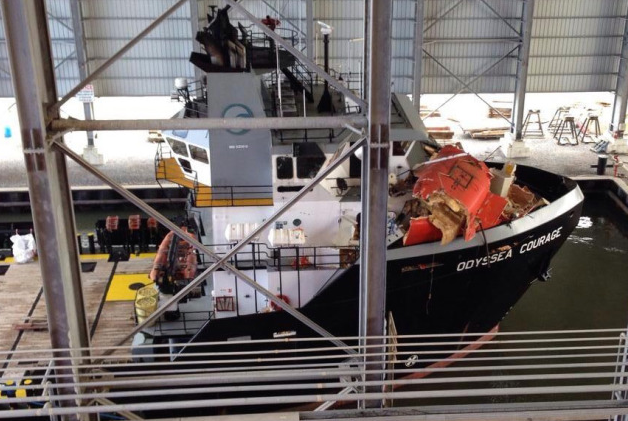
The Odyssea Courage With Bits of the Q4000 Lifeboat on the Bow
In the early morning of Saturday 15th November the platform supply vessel Odyssea Courage hammered into the stern of the Helix well intervention semi-submersible Q4000, in the Gulf of Mexico. The ship then retired hurt to Port Fouchon, and was photographed with the remains of a lifeboat on the bow, and the rig was allowed to continue working, with its three remaining lifeboats still available.
This is not the first time a collision between a ship and a rig has been featured in this newsletter, and it probably won’t be the last. In fact despite the increasing availability of dynamic positioning, supposedly removing the human factor from the task of operating a ship close to an offshore structure, things don’t seem to be getting any better.
Your scribe has investigated these sort of collisions on behalf of clients, has reviewed reports on them, written collision risk management manuals, and actually been master of a ship which ran into a rig. So for those who would like to know more here are a few words on the topic starting off with my own experience.
My own collision occurred when I was master of a British registered anchor-handler (so it had to be a long time ago) supporting a Pentagon rig in the UK sector of the North Sea. Pentagons are unusual in having five columns. From starboard aft the legs are named A to E with C being the bow leg. Back in those days we used to tie up, first dropping an anchor and backing in to be secured by ropes to the port and starboard quarters. On this day I had lined the ship up with the rig and started backing up, pulling the string which operated the ship’s whistle once, which indicated to the mate that he should let the anchor go. As I closed up with the D leg I pulled the string for the whistle twice, which was the signal for the mate to stop letting out the anchor, but there was no sound, apart from that of the anchor chain still rattling out. I went to the engine controls and pulled them both up into the neutral position. Nothing happened. I put the engines to full ahead, but still nothing happened and the ship hit the rig pretty hard, stamping an outline of the welds on the port quarter into the leg, but fortunately not making a hole. Then the engines caught and we powered away.
This was a collision due to mechanical failure, actually lack of control air. Mechanical failure is the least likely to result in contact between a ship and a rig, although failures of the DP (dynamic positioning) systems and a consequent failure of the watch keeper to take the right corrective action are the cause of some.
But it appears that the most likely causes of collision are lack of attention on the parts of the watch keepers on ships rendezvousing with offshore installations. Don’t they have radar? I hear you ask, and the answer is yes of course, and in some cases the offshore installation has radar as well.
So following the progress of a typical collision, which may or may not be what happened to the Odyssea Courage, we can start with the ship a few miles off, approaching the rig at transit speed with the intent of working cargo on arrival. There may well have been an exchange of operational messages between the watch keeper and the control room of the unit, hence the vessel is expected. Thereafter it may be the lack of attention on the part of the watch keeper which results in the collision. On one occasion, in the Irish Sea, the Captain had sent the lookout down to call the crew for the day’s work, and he himself had reduced speed and got on with a bit of paperwork. But the reduction in speed was not enough, and looking up from the chart table he saw the platform close ahead. He went full astern but the collision still occurred.
At a more basic level it is possible that the watch keeper is the only person in the Pilot House and so, in order to get everyone ready for work on arrival, he goes down below and calls people, and while he’s there he pours himself a cup of coffee, and starts chatting to others as they arrive in the Mess Room. He has forgotten what is going on upstairs! Some people would not believe that this could be happening, but it does, and has done on a number of occasions.
Similarly when the regulations require the presence of a standby vessel, these ships can themselves become a hazard, particularly when the watch keeper loses concentration, falls asleep, and more commonly in today’s world, become absorbed in a computer game. We can have a little sympathy. It is a boring job.
In safety engineer’s jargon these are known as “visiting vessel collisions”. This is as opposed to “passing vessel collisions”, and it might appear that the latter would be more frequent. Yes, they have happened but there have been very few, yet it is passing vessel collisions which most exercise the minds of the owners and operators of offshore installations. What would the offshore management do if they saw a ship approaching them at full speed? Would they even see an approaching vessel? How much time would they have to do anything? There are some answers to these questions, most of which depend on the availability of a suitable detection system – a radar, a standby vessel or something. But even given a warning what should the prudent OIM (Offshore Installation Manager) do? Some advocate evacuation, but what if the ship turns off at the last moment and sinks a lifeboat full of people? After all these years there are still more questions than answers. However, today there is a means by which the possibility of collision with a passing vessel may be reduced. It is a legal requirement that all ships of more than 300 gross tons must be fitted with AIS (an Automatic Identification System), and nothing prevents this relatively low cost system from being fitted to offshore installations and mobile units. Passing vessels would therefore see the objects on their various navigation systems, and could take appropriate action to keep clear.
So given all of the above the best opportunity the offshore installation has to reduce the possibility of collision is to control the operation of visiting vessels. And once more I hear people saying “surely they do that!” Well, yes and no. There is a tendency for those on board offshore installations to put quite unwarranted faith in the machinery and the management of visiting vessels. So here are a few hints. First set a safety perimeter round the installation. The UK sector has a 500 metre perimeter by law, but it does not have to be that. Then set up a requirement for any visiting vessel to linger at the edge of the perimeter and check its equipment and then to approach with caution, and make sure they know they have to do this. Try to keep the lee side of the facility available. And don’t let work carry on in adverse weather, even if the ship says it can.
And finally Never Let Your Visiting Vessels Head Straight for the Rig!!
RIGS TO REEFS

A Hurricane Damaged Offshore Platform
One of the reasons oil rigs offshore Europe are protected by a 500 metre exclusion zone is that otherwise fishing boats would be sailing right up to the legs, because fish love oil related architecture. Even though they can’t get that close to the structures above the surface they trawl alongside the undersea pipelines, which are also favoured by our fishy friends.
Out in the Gulf of Mexico it is accepted that the presence of the oil platforms have created wonderful habitats for fish, in an area which was otherwise reef free. But in recent years the earliest platforms have ceased production and have therefore been removed, thereby removing the marine habitat.
This loss of habitat has been so severe that the various government bodies which have replaced the MMS (Minerals Management Service) have been lobbied, and as a result the “Rigs to Reefs” programme was initiated.
Of particular interest today is the fact that a platform which was toppled by hurricane Ike in 2008 is scheduled for removal and a Louisiana senator has lent weight to the campaign to allow it to stay. “…the thriving ecosystem that has grown around it is already playing an important role,” he wrote.
However the current regulatory regime the Bureau of Safety and Environmental Enforcement (BSEE) seems unlikely to accede to the request, suggesting it amounts to “ocean dumping”. More on this story later!