


THE ARCTIC SUNRISE AFFAIR
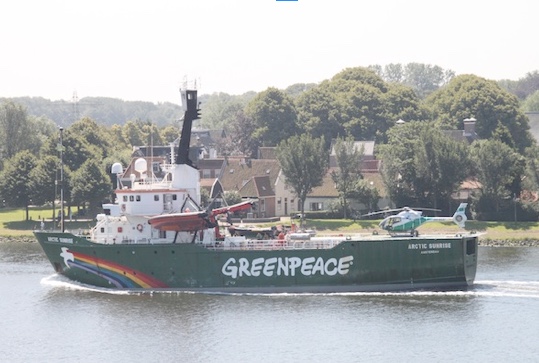
The Arctic Sunrise. Photo Jan Plug
Today, a little more than a month after the Greenpeace protest at the Priraziomnaya, where the protesters claimed that they just climbed aboard the rig in order to plant a banner, all those involved are still in jail in Murmansk and the ship is at anchor outside the port. This after Russian special forces were helicoptered aboard and took over.
The 28 Greenpeace activists and two journalists were originally charged with piracy but more recently the charge was reduced to ‘hooliganism’, which carries a lesser sentence. This is all extremely harsh and honestly you would think that the organization – Greenpeace - would have assessed the risks of such a venture. But then they don’t seem to assess the risks relating to their other activities very well.
Of course not everyone will be distressed by this sequence of events. For many years it appears that the environmentalists have used the oil industry as a means of publicizing their activities, with the possible objective of increasing their revenue. And of course in the west the oil companies have taken a view that the best action is no action, particularly after Brent Spar where Greenpeace succeeded in reversing Shell’s decision to dump the redundant structure in the Atlantic. Shell possibly made the error of taking aggressive action against the protesters who had taken up residence on the structure, by spraying them with fire monitors from support vessels. This had the effect of ensuring that the event remained in the news. In the end much of what Greenpeace had claimed about the spar turned out to be false, but by then it was too late.
SOMETHING FROM THE COSTA CONCORDIA TRIAL
There have been reports all over the media about the testimony of the Moldovan dancer Domnica Cemortan at the trial of Captain Schettino, who faces charges of causing a shipwreck and abandoning ship. She admitted that, after all, she and the Captain had a relationship. This was said, therefore, to cast doubt on her previous testimony that he had been a hero, in navigating the ship to shallow water. I don’t think we needed her new admission for us to be doubting his heroics, since according to the accident investigation it was an extraordinary stroke of luck that the ship drifted onto the ledge outside Giglio harbour. And there may be some cynics who felt that her presence on the bridge of the ship, with neither a ticket or a place on the crew list, indicated that she was more than a friend.
CAPTAIN PHILLIPS

Tom Hanks as Captain Phillips in the film.
The other week I went to see the much lauded film ‘Captain Phillips’, actually named after the captain of the Maersk Alabama, who was taken hostage by a group of Somali pirates back in 2009.
The film was directed by Paul Greengrass, and I find that, if it is possible for one to be a fan of a film director, I am a fan. He just hits the spot when it comes to tension and action. And so it is with Captain Phillips and the Maersk Alabama.
Even if you remember the event and how it all went the film will have you on the edge of your seat throughout. And even for we seafarers there is virtually nothing we can dispute – except actually the fact that Captain Phillips did not appear to have anyone hand over command to him. But that would have been a dramatic disaster, so they are forgiven.
However, the broadsheets have reported that in the real world eleven of the Maersk Alabama crew are taking Maersk to court for damages, since it seems that the captain of the title ignored seven warning of possible pirate attacks and failed to take any notice of company instructions on means of defence.
And even more interesting, or entertaining, depending on your frame of mind, is that the $30,000 from the ship’s safe which was given to the pirates, and could have been recovered, has disappeared.
I’m trying to avoid spoilers here!
THE NEFTEGAZ 67 AND THE YAO HAI COLISION

The Neftegaz 55 - a sister ship to the Neftegaz 67. Photo Wullie Bremner
The Nautical Institute Hong Kong branch recently held an evening seminar where they discussed the Neftegaz 67/ Yao Hai collision which resulted in a court case and the imprisonment of the captain of the supply ship. They were specifically discussing the relevance of Rule 9 of the Collision Regulations which determines the actions to be taken by vessels in narrow channels. The event was reported in the NI magazine ‘Seaways’, and the reason for this discussion was that the success of the prosecution hinged on the acceptance that Rule 9 was applicable at the time. (Readers should be aware that I have interpreted the documents available on the internet). The accident resulted in the deaths of 18 of the 25 crew members on board the Neftegaz 67.
So how did it go? The accident occurred on the evening of 22nd March 2008. The Yao Hai was a bulk carrier carrying 57000 tons of maize, and was inbound to Shekou on a course a little to the south of west and the Neftegaz 67 was a supply vessel, of the standard Russian design on an easterly course from a supply base to a rig offshore. The supply ship’s course which, if one reads their defense aright, happened to be within a deep water buoyed channel marked for the benefit of coal carriers on their way to a power station. The Yao Hai was approaching the CP1 and CP2 buoys, the outer marks of this channel on a course which would have put it on the starboard side.
The bulk carrier had a senior and junior pilot on board, the master and the crew were Chinese. The supply ship was being conned by its master Captain Kulemesin who like the rest of the crew, except for a Chinese advisor, was a Ukranian.
The visibility was about two miles, and at about 2009 the second pilot on the Yao Hai, which was now travelling at about 12 knots, identified a vessel on a possible collision course one point on the starboard bow at about 2.5 miles. The target was the Neftegaz 67 outward bound at about 10 knots. Shortly thereafter the Yao Hai made a small alteration to starboard, the Neftegaz 67 remaining fine on the starboard bow. The co-pilot attempted to attract the attention of the supply vessel by flashing the Aldis in its direction.
At 2010 the two ships showed up as potentially colliding on the Vessel Traffic Centre radar system. At 2111 the pilot asked the co-Pilot to contact the VTC with a request to provide information about the target, and to advise the Neftegas 67 that the two vessels should pass port to port so as to avoid collision.
At 2112 the pilot instructed the Yeo Hai helmsman to alter course slowly to starboard and the ship entered the deep water channel. At the same time the VTC Western Approaches work station contacted the supply vessel and warned it of the impending collision and to take avoiding action. Similarly the harbour workstation contacted the Yeo Hai and warned it of the danger. Thereafter further warnings were issued resulting in no response from the Yeo Hai and an incomprehensible message from the Neftegaz 67.
At 2113 the ships were more or less end on and approaching each other at a combined speed of about 23 knots. The VTC warning system indicated that collision would occur in 1 minute and 17.5 seconds if immediate action was not taken.
This need for action became apparent to both vessels, and the pilot of the Yao Hai gave helm orders altering the heading to starboard. At more or less the same time the Neftegaz 67 altered course to port. Both vessels blew their whistles in what they regarded as being the appropriate manner. In the view of the writer, by the time it gets to whistle blowing it is all too late.
Almost inevitably Yao Hai ploughed into the Neftegaz 67 at a point half way down the main deck on the starboard side. The bulbous bow of the bulk carrier penetrated the starboard stern tube and the bow itself holed the hull in the area of a store aft of the engine room. The impact of the bulbous bow on the prop shaft rolled the supply ship to starboard, ie towards the oncoming Yao Hai.
The Neftegaz 67 rapidly took a starboard list. The open watertight doors below decks allowed water to enter the engine room, and the stability assessment attached to the marine investigation report determined that the ship had capsized due to free surface underdeck, and also that if the watertight doors had been shut the ship would have remained afloat.
The report on the accident hardly mentions Rule 9 – which is where we came in. Nearly all the required actions according to the investigators should have been taken by the Yeo Hai, which as the giving way vessel should have made early and substantial alterations to starboard to pass outside the CP1 buoy marking the edge of the deep water channel, and in any case it should have slowed down.
The Neftegaz 67 as the stand on vessel should not have altered to port.
One gets the feeling that the VHF comms were disadvantageous, giving the Yao Hai the impression that the Neftegaz 67 would respond. But did the Captain of the latter understand? And why did the court rule that the deep water channel was a ‘narrow channel’ where Rule 9 would be applicable? Despite a reduction in his sentence on appeal Captain Kulemesin is still in prison and will not be released until next year.
THE DANNY FII REPORT
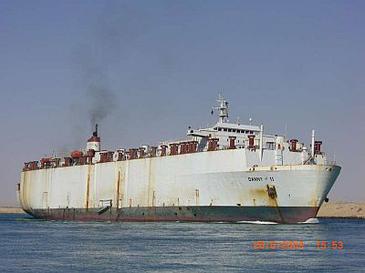
The Danny FII after conversion.
Everybody has a view, and it was the view of the World Society for the Protection of Animals that the deaths of 30,000 animals which were the cargo of the Danny FII is an indication that the transport of live animals by sea is cruel.
Well yes, it probably is, but the deaths of more than 40 of her crew when the ship sank in December 2009, are probably more important. The ship’s captain and the electrician both of whom were lost, were members of Nautilus, the UK based seafarers union, and they called at the time for an investigation into the casualty, particularly since the vessel seems to have overturned in only moderate weather.
As I wrote in early 2010 the Danny FII was a converted car carrier, and it is still possible to see details of the conversion in places on the internet. My question then was, could the animals themselves have acted as free surface.
But now, having waited for nearly four years the Panamanian authorities have completed their investigations, but the Nautilus Telegraph writes that the investigation is to remain confidential. Can this possibly be legal. If it is, it is certainly not morally acceptable.