


On June 8 2009 the well stimulation vessel Big Orange XVIII collided with the water injection platform Ekofisk 2/4-W causing serious damage to both the vessel and the platform. No-one was injured but because the incident had the potential to be a major accident it was investigated by the Norwegian Petroleum Safety Authority, which reported on October 2 2009.
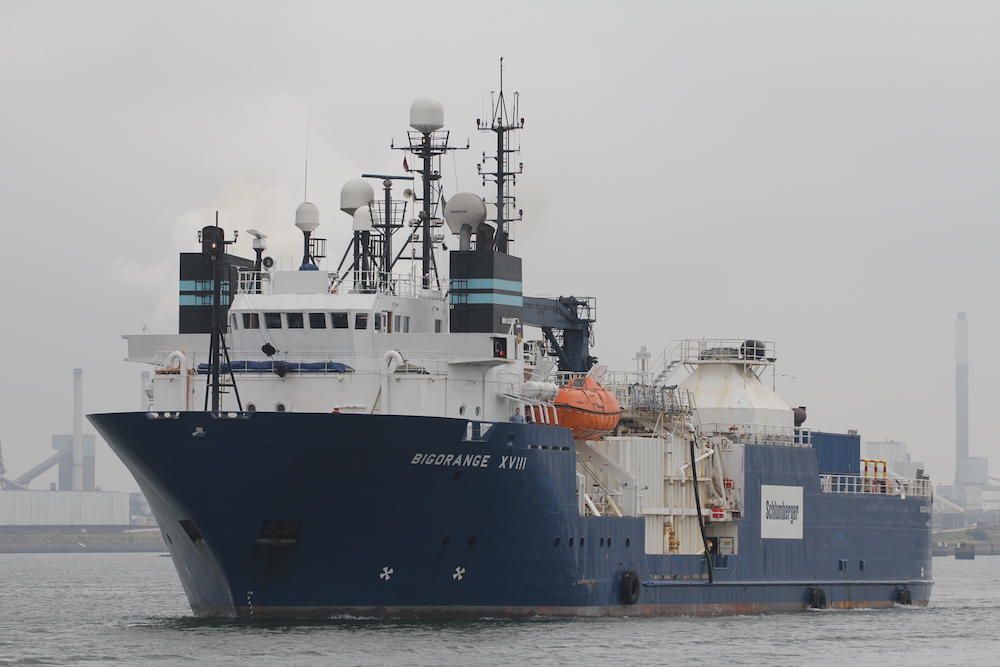
THE VESSELS INVOLVED.
The Big Orange XVIII was built as a well stimulation vessel in 1984. It was 243 feet (74 metres) long and was about 2000 tonnes deadweight. It was provided with three main engines offering collectively 12,440 bhp which in turn power two bowthrusters and two Ulstein azimuthing thrusters aft. In order to go astern the azimuthing thrusters had to be rotated. It was classed as a DPII vessel and had accommodation for 30 people. The ship was managed by Wilhelmsen Ship Management and was chartered by Schlumberger. Judging by the name it had been once owned and managed by Schlumberger who used to operate a fleet of well stimulation vessels all of them named Big Orange something.
Ekofisk was an enormous field, the first discovered in the Norwegian sector of the North Sea. Many of the platforms were connected by bridges and the small platform 2/4-W was originally a bridge support installed in 1972. It was converted into a water injection facility in 1989. At all times there were jack-ups in the field with their derricks cantilevered over some platforms carrying out well maintenance.
The Northern Crusader was a ME303 anchor-handler built in Singapore in 1992, and originally called Monica Viking. This ship was 73 metres (239 feet) long and powered by four Wartsila engines giving it a 166 ton bollard pull. Its actual purpose in the Ekofisk Field on July 8th 2009, was not explained by the report.
The standby vessel Esvagt Corona was a 44 metre (144 feet) ship with a capacity for 250 survivors in Norway, built in 2004. It was provided with two fast rescue craft.
THE PREAMBLE.
The Big Orange XVIII had spent some time at the end of the previous month stimulating wells at Ekofisk, and hence there was some familiarity between the ship and the field, but it had returned to Montrose for a crew change, and had then sailed back to the field to stand by.
In June 2005 the Ocean Carrier, a platform supply vessel had collided with the bridge between Ekofisk 2/4-P and Ekofisk 2/4-T and this had resulted in a number of internal recommendations within the ConocoPhillips marine controls, particularly changes to the Marine Operations Manual and the requirements for the operation of vessels using autopilot within the 500 metre zone.
On the day of the event the Big Orange XVIII was standing by, adjacent to the field, waiting for instructions to go to work. The Second Mate was on watch. It was his first trip on the vessel.
Initial instructions were given for the vessel to approach by “Ekofisk Radar” but this facility did not monitor vessels inside the 500 metre zone, responsibility being handed over to the OIM.
THE SEQUENCE OF EVENTS.
June 8 2009.
0340. Big Orange XVIII is called by Ekofisk Radar to prepare for well stimulation of well X16. The Second Mate calls the Captain.
0400. The Captain arrives on the Bridge and takes over control from the Second Mate. He asks Ekofisk Radar for permission to enter the 500 metre zone.
0402. The Schlumberger man on Ekofisk 2/4-X calls the ship, and the Captain leaves the Bridge and goes to the Radio Room to answer the call, first resetting the autopilot. After about 30 seconds he returns.
0406-0408. The ship’s speed exceeds the permitted speed of 8 knots, but there is no reaction to this from the personnel at Ekofisk Radar.
0411. The ship is given permission to enter the 500 metre zone. The Second Mate has carried out the checklist.
0413. The Captain reduces speed and attempts to turn, to go astern to the platform Ekofisk 2/4-X. The vessel does not respond to the manoeuvre.
0414. The ship is now proceeding out of control towards the complex. The Captain sets the azimuthing thruster controls to the astern position and increases the power, so that he thinks the ship should be going full astern.
0415. The vessel increases speed. The Captain thinks the steering has failed, activates the emergency steering and uses the bowthrusters to steer. The ship passes under the walkway connecting Ekofisk 2/4-X and the adjacent bridge support at a speed of 6.7 knots. Everything on the ship above the Bridge is torn off by impact with the structure connecting two platforms.
0416. The ship continues to increase speed and passes the accommodation rig COSL Rigmar at a distance of between four and ten metres (20 feet approximately), leaving it to port.
0417. Big Orange XVIII collides with Ekofisk 2/4-W at a speed of more than 9 knots. The fire alarm goes off on the ship. Ekofisk Radar calls the anchor-handler Northern Crusader to go to the assistance of the stimulation vessel.
0419. The Big Orange XVIII turns to starboard under the walkway between Ekofisk 2/4-W and 2/4-FTP. The Captain stops the main engines. The Ekofisk Central Control Room shuts down the damaged platform and the Esvagt Corona is ordered to go to the scene and launch an FRC.
0423. The Esvagt Corona FRC arrives on scene.
0427. The Northern Crusader is closed up with the Big Orange XVIII.
0428. The Local Emergency Preparedness Centre is mobilised. And by now a number of other onshore Emergency Centres have been informed or have been activated, although their precise roles are not explained in the report, nor are their contributions to control of the emergency, if any, identified.
0435. The Big Orange XVIII backs off using its own engines, and impacts with the stern of the Northern Crusader. Both ships suffer minor damage.
0439. The Big Orange XVIII is taken in tow by the Northern Crusader, and is moved to a safe location.
0441. The production from Ekofisk 2/4-A is shut down, and the gangway and the equipment relating to the damaged platform also shut down.
0525. The Tananger Emergency Preparedness Centre is mobilised, and subsequently there are numerous exchanges between this centre and the PSA’s emergency personnel. These centres, and possibly others, exchange information about the circumstances of the accident and the status of the platforms, the production and the vessels, for some time.
0830. The PSA stands down its emergency preparedness centre.
1345. The Tananger Emergency Preparedness Centre is demobilised.
THE INVESTIGATION.
The principal finding of the investigation was that the Captain had reselected the autopilot when approaching the 500 metre zone, due to the need to go to the Radio Room to receive a phone call. On his return he had forgotten that he had done this. Although it is not specifically stated it is more or less assumed that he did this because the Second Mate was inexperienced. And it is certain that the Second Mate failed to remind the Captain to reselect hand steering. In addition the Captain had stated that he would test the DP system when 350 metres from the platforms but did not take steps to do so, but the Second Mate had ticked all the boxes on the arrival checklist.
The report goes into detail about the damage to the water injection platform, which was considerable, and resulted in temporary structural changes being made by the heavy lift vessel Thialf. Later the intent was to remove the platform altogether and to plug and abandon the water injection well using a jack-up. The result of the accident, and the shutting down of the water inject wells resulted in a loss of pressure in the reservoir and therefore reduced production from the field, until a new water injection system could be provided.
The investigators spent some time describing what the possible consequences of the accident could have been, and maybe the most important was the possible impact with the COSL Rigmar which could accommodate up to 290 people, although the actual numbers on board at the time were not identified. The loss of one of the jack-up’s legs would have tipped it into the sea. There was also the possibility that the ship could have hit an accommodation platform for 120 people, or an eight inch gas pipeline, with catastrophic consequences.
Since hydrocarbons were transferred between different facilities on the various connecting walkways there was the possibility that there could have been a major pollution event, and side damage to the ship could have resulted in the release of some of the noxious fluids it was carrying in its deck tanks.
The investigation determined that there were a number of failings on board the ship, including failure to communicate properly on the Bridge and failure to ensure that the Second Mate had the required levels of familiarisation. The actual words in the report are “sufficient level of competence” but since he was obviously qualified and therefore was in possession of a “Certificate of Competency” this statement could be incorrect. Also the master had had insufficient rest prior to going to work. 8.5 hours and opposed to the required 10 hours. In addition to the failure to properly control the activities taking place on the Bridge, the report states that virtually all marine conventions were not complied with.
These failings resulted in a requirement that ConocoPhillips take steps to improve their procedures in a variety of ways. The nub of the recommendations were that measures should be put in place to achieve better management of vessel contracts. And specifically they were required to evaluate how the requirements related to entering safety zones, as specified in the Marine Operations Manual and the OLF’s guidelines 061 (The Norwegian guidelines for support vessel operations) could be complied with in practice. It was also recommended that a work group be appointed to review the work routines at Ekofisk Radar. One should bear in mind that these were the recommendations from the 2005 Ocean Carrier accident but they had not been carried out by ConocoPhillips. The 2009 recommendations were a little less specific which could be summarised as “do things more safely”.
COMMENT.
As the investigation determined, this is not the first time it has happened, and not the first time at Ekofisk, for exactly the same reasons. And there have been similar accidents elsewhere. Now it might have occurred to those of us who have cars with cruise control, that the control deselects when you put your foot on the brake and restores the control of that function, and that of the accelerator. So could not the autopilots deselect when one operates the steering, whatever that might be? On an offshore support vessel it is most usually just a small tiller, and so it is a matter of just a turn of the wrist to go hard to port or hard to starboard. The controls to operate aft azimuthing thrusters can be more complicated, sometimes requiring that the tiller be turned to port to get the ship to turn to starboard, and at times requiring that the power to the thrusters be increased. This need to increase power to get the ship to turn seems to be inherent in these systems, and since there are more and more ships powered in this manner it may be something the naval architects should address.
Some marine experts would also say that there was a case for some sort of bridge management training, but this is getting to be a constant recommendation if things go wrong on a ship. This sort of proposal pivots on the contribution to the operation that has been made by the bridge team. In this case the team was under the control of the Captain and the rest of it was the Second Mate. And it was determined that the Second Mate was inexperienced as far as the Big Orange XVIII was concerned, although his experience in the support vessel business or his experience at sea were not recorded. But at the very least it should have been apparent to the Second Mate that the Captain had not restored the vessel to hand steering.
In the end we get back to the basic recommendation which exists in numerous marine guidance documents. “Don’t head straight for the platform”.