


I realised that I was uploading accident reports from 2014 onto the website when I should be providing my readers with a consolidated review of the Key bridge accident, so here it is.
In the early hours of the morning on Tuesday 26th March the large container ship, Dali, ran into a pylon of the Francis Scott Key bridge, in the entrance to Baltimore harbour, resulting in the collapse of the whole bridge into the water. Eight men who were working on the bridge filling in potholes fell into the water, two being rescued and the other six dying, all of them of Central American heritage. Fortunately for the whole event police were manning the ends of the bridge to assist with the pothole filling, and on receipt of a last minute warning were able to stop the traffic. There were no casualties on board the ship, although subsequent to the allision it remained pinned under the remains of the bridge. (update 27th June 2024)
The bridge was opened on 23 March 1977, named after the author if a poem on which the “Star Spangled Banner” is based. It is, or has been, generally known as “The Key Bridge”. It lacked the protection for the pylons which is used on more modern bridges. It and a further 16,800 bridges in USA are classified as "fracture critical", meaning that if one component of its primary structure fails then all or most of the span will collapse.
The Dali is one of a number of sister ships built in Ulsan, South Korea, by Hyundai in 2015, which rolled off the stocks at three month intervals including the Cezanne, the Modigliani, the Matise and the El Greco, plus some for other owners.
The ships, known as the "Cezanne" class, are 299.92 metres (984 ft.) long, 48.2 metres (158 ft.) wide with a deadweight of 116,851 tonnes. They can carry an equivalent of 9971 twenty foot containers. They have a service speed of 22 knots.
They are provided with a single diesel engine developing 41,480 kW (55,630 hp) directly connected to a fixed pitch propeller. They are equipped with a bowthruster of 3000 kW (4000 hp).There are four independent generators developing collectively 16,480 kW. Some of the generating capacity is used to provide power to the refrigerated containers.
The Dali is registered in Singapore. It is owned by what looks like a single ship company, Grace Ocean Pte Ltd, a technique used by many shipowners to limit their liability in the event of an accident. It is managed by the Synergy Marine Group.
These ships are the workhorses of the container business. The Dali (named after the Spanish painter Salvadore Dali), is on charter to Maersk, which it seems has resulted in it having a Maersk funnel.

The Cezanne. Photo by Rick Vance
The sequence of events.
The vessel departs the port of Baltimore with a pilot (and an apprentice pilot) on board. It leaves the berth and makes its way into the main channel which leads under the central span of the bridge and onwards to Chesapeake Bay.
There are a variety of time lines available on the internet, from the black box, and also from videos of the event. It looks like it went like this:
The ship leaves the berth turns 180 degrees and enters a secondary marked channel doing 6.4 knots. The tugs leave. Then once in the main channel speeds up to 8.4 knots
1.24: The ship is approaching the bridge at about 7 knots. Traffic can be seen going over it.
1.24.30: All the lights on the ship go out. It looks like a complete power failure, and it has been postulated that the loss of power coincided with an instruction that the bow thruster was finished with.
1.25: Several alarms are heard.
1.25.33: The lights come on again. There is still traffic going over the bridge, and the ship is still moving ahead possibly at 8 knots.
1.25.53: Smoke indicates that the ship is going full astern. The bow moves to starboard, due to the propeller effect, but the ship is still moving forward.
1.26.39: The pilot asks for tug assistance.
1.26.40: The lights seem to go out again. Again people have associated this power failure with the bow thruster, possibly after the engineers have been instructed to start it up again. There is still traffic going over the bridge.
1.27.22: The port anchor is let go.
1.27.25: The pilot calls the authorities to tell them that the Dali has lost power and is approaching the bridge out of control. Traffic is stopped at either end. The ship is apparently still doing 7 knots, but maybe not, the AIS system lags behind reality in its presentations, the videos still showed it doing1.5 knots even after the bridge collapse.
1.28.45: The ship hits the protection around the pylon and then the pylon.
1.29.33 The pilot reports that the bridge is down.
There is much discussion on social media about the rudder and propeller effects, which depend on the speed of the ship, the flow of water past the propeller and the direction of its operation.
There is always a transverse effect of a propeller, but if the ship is going ahead the rudder masks this effect. One assumes that it is a combination of water flow past the prop due to the speed of the ship, and the water flow due to the operation of the propeller. If the propeller stops then the effect of the rudder depends on the water flow past it due to the movement of the ship through the water. On some ships the ability to steer is quickly lost if there is no propulsion. It would be reasonable to say that with the speed falling off and the engine now going astern the propeller effect moving the stern to port would overcome the rudder effect, using solely the water flow due to the ship moving through the water. Had they managed to get the bow thrust going and had given it full port thrust the ship could have been moved sideways as well as moving forwards (Just my view but based on experience with small ships).
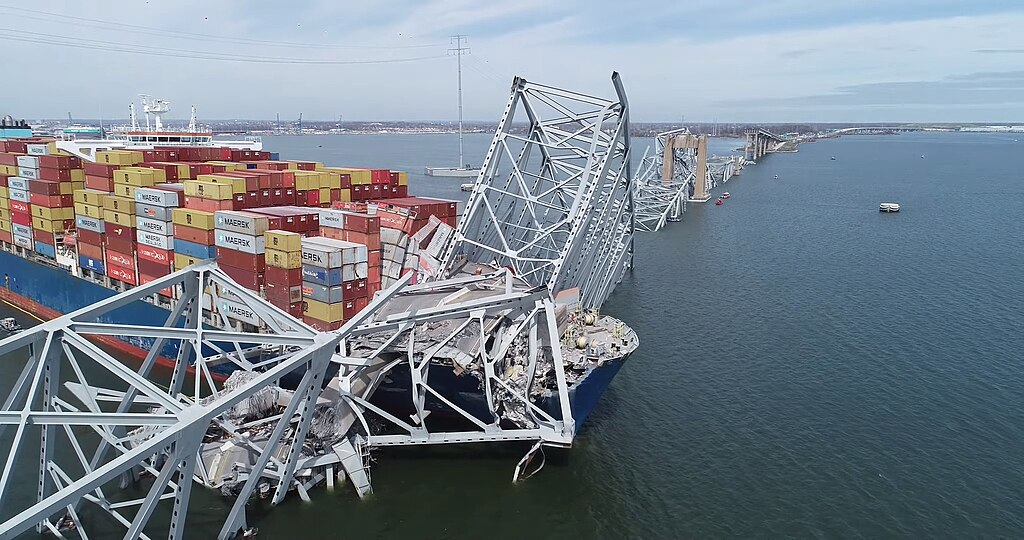
The Aftermath of the Accident from the NTSB site
Subsequent activities.
There must have been a stunned silence as everybody watched the bridge collapse like a poorly constructed Meccano project, and almost immediately there were discussions in social media about the construction of the bridge and how things had changed since the 1970s when it was built. There is a point where we should be discussing risk assessment, maybe later. But we can be pretty certain that any such process would have been fairly casual. You can see if you look at any of the AIS presentations that the channel to the sea extends right up to the sides of the bridge supports. Some other bridge supports in America are apparently protected by gravel dumped around them.
On Monday 1st April the Army Corps of engineers had managed to open up a secondary channel which allowed some tug/barge combinations to transit. They have gone on to try to provide another channel with a depth of more than 20 ft. A “Unified Command” has been set up with the primary objective being to clear the main shipping channel. This is a complex process made more difficult because the remains of the span are partially buried in the mud.
On 7th April the unified command announced that containers were being removed to gain access to the portion of the bridge which is on the bow of the ship. They are using the Weeks 533 crane which has a capacity of over 400 tonnes and is the largest revolving floating crane on the East coast. It is more than 50 years old. It is a famous crane having been used to lift many important objects including a space shuttle and a Concorde, and indeed it is not the first time it has featured on this site.
On 10th April the NTSB Chairperson Jennifer Homendy informed us all how things had been going with the investigation. She said that a lot of people on the ship had been interviewed, the US Coast Guard watch standers who had been on duty at the time, and some interviews with tug operators. She said that people formally included in the enquiry were the ship's owners and managers, the Coast Guard, the Maryland Transportation Authority, the pilots, and experts from the ships equipment manufacturers. Some commentators believe that Kongsberg is the manufacturer of the ship's control systems.
17th April. New info. The FBI boarded the Dali on Monday causing much speculation as to what the result of their visit could be. However, they have already said that they are saying nothing. People think that the Captain and the Chief Engineer could be arrested, for what we don't know. Favourites are the that they may have concealed deficiencies in the ship's equipment which under federal law should have been declared to the authorities. Engine experts are suggesting that if all the power went down as it seems to have done there was no way the engine could have been restarted in such a short time. This of course negates the theory that the ship going astern caused the bow to move to starboard.
Meanwhile I am waiting to see some sort of risk assessment carried out by the port authority taking in the possibility, or not, of the bridge supports being hit by an errant vessel.
19th April. The guys on gCaptain have got round to discussing risk assessments, and one of them has turned up the NTSB report of the Tampa Bridge allision from 1981. This report quotes a French assessment of bridge vulnerability, which required that all bridges be protected from ship impact, considered to be a likely event. The report contained a number of recommendations relating to the protection of bridges from ship impact, particularly which ones would be considered to be the most vulnerable, and the development of standards for their protection. The contributor asked "what steps were taken by the MTA regarding the Key bridge protection following the NTSB report release?" The answer is obvious, but we might ask what justification was provided for doing nothing.
13th May. Although the engineers have been working away at cutting up bits of the bridge and opening various channels of various depths, there have been no public statements by anybody, and I like to hear experts telling us what's going on. There have been rumours that there was going to be a controlled explosion, blowing up the bit of the bridge leaning on the port bow of the ship, and if we judge the news broadcast to be true, this has happened, but the ship is still in th same place, so it was not actually released. Maybe this will happen soon.
More, actually there have been statements from important people. Lieutenant General Scott Spellmon said, "it is a lot like peeling an onion", and others at th same news conference said that the ship could be moved in a couple of days. If you look at the photos there is still quite a bit of carriageway on the foredeck. US Coast Guard Rear Admiral Shannon Gilreath said that they intended to deballast the ship and pull it out into the channel with four tugs. They hope to reopen the channel by the end of the month.
24th May. A few days ago the NTSB made an interim presentation about the allision of the Dali into the Baltimore Bridge, concentrating in the main on the way the power was lost, apparently due to the bus bars disengaging for no apparent reason. These on the switchboard of the ship are actually heavy duty switches, which were re-engaged manually to provide power from the four generators, which had actually not stopped running. However once power to the various systems supporting the main engine was lost, it shut down and waited to be supported again. Some have said that when power was engaged again all the pumps should have restarted automatically, but maybe they did not and at some time after attempts were made to restart the engine power was lost again. A diagram provided by the NTSB seems to indicate that a single failure in the switching will cause a shut down. While others have suggested ways of providing some redundancy, not a requirement apparently for large commercial vessels. Despite a lot of study, the presentation and the discussion does not mean a lot to me, a non-engineer who has not been on a deep sea ship since 1968.
However, apparently, when the power was lost the emergency generator started up, as it was supposed to do, providing power to essential systems. One of these was apparently one of the three steering pumps, which should have allowed the rudder angle to be altered, albeit slowly, on the instruction of the pilot ,who had called for hard aport to alter the direction of travel back into the channel. There is no indication that this instruction was carried out, or if it was whether the rudder actually moved. Also we knew that the port anchor had been let go, but the interim statement revealed that the man on the forecastle had not put the brake on before running for safety, amid falling steelwork and bits of carriageway.
Also a few days ago the ship was released from the wreck of the bridge and has been returned to the port.
This could be all we are going to get for a very long time as the various bodies involved come to their conclusions, however there have already been changes in pilotage arrangements for Baltimore, now requiring escort tugs to be involved in departures and probably arrivals. Horses and stable doors are mentioned in social media.
May 31st. I was wrong, there is more. It appears that the Washington Post has been at work to uncover records of safety meetings held by the Baltimore Harbor Safety and Coordination Committee, and have found that as long ago as 2004 concerns were raised about the vulnerability of the Francis Scott Key Bridge by the senior pilot, Captain Smith. He apparently continued to raise concerns for a further six years until he retired, after which no-one addressed the topic again.
Meanwhile the organisation in charge of the Delaware Memorial Bridge have determined that protection for the bridge is necessary, and at the moment eight protective dolphins are being constructed, with the hope that the work will be finished next year. The cost will be $93 million. This can probably set against the cost of replacing the Francis Scott Key bridge which will be $2 billion. However, in the latter case the Maryland Transport Authority will be expecting someone else to pay.
27th June. It has bee reported this week that the Dali has sailed away from Baltimore to Norfolk, Virginia, under the guidance of the salvage company Resolve Marine. It is said to have a full crew, although it was earlier reported that some have been repatriated, but four of the original crew are remaining with the vessel and seven others are ashore in hotels. Replacements have been provided by Synergy marine. There is work to do, the bow is still damaged and it has no anchors, so it is said that further repairs will be carried out to make the ship safe so that it can be sailed to a repair yard, probably in the far east for further refurbishment.